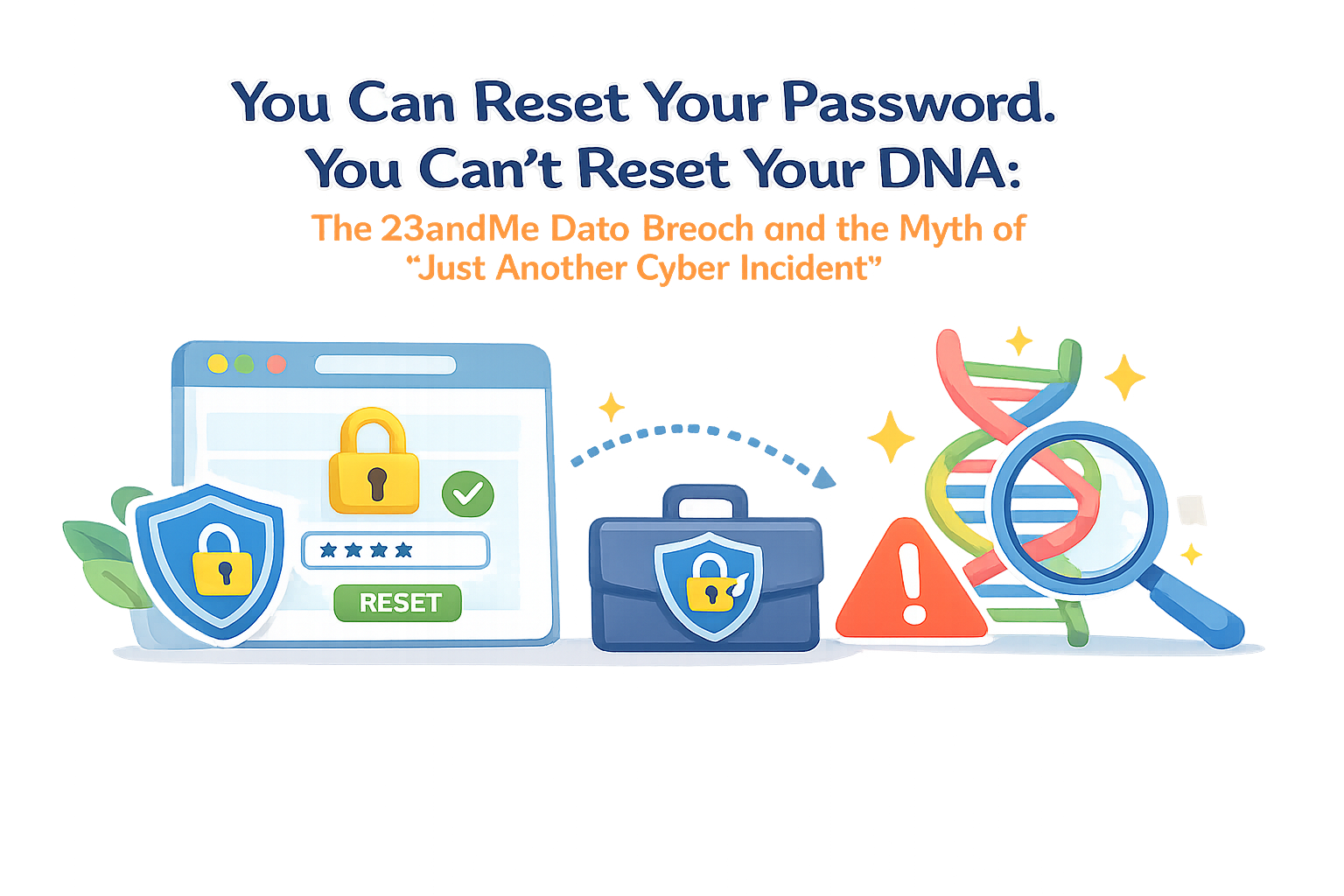
When a password leaks, you change it.
When a credit card is stolen, you cancel it.
When your genetic data is exposed, you live with it forever.
The 23andMe genetic data breach was widely framed as a credential stuffing incident rather than a traditional system hack. That framing may be technically convenient. It is also strategically incomplete.
Because this was never just a login issue; it was a governance failure involving permanent biological data.
In late 2023, attackers used credential stuffing techniques to access thousands of accounts using reused passwords from unrelated breaches. While the initial access point involved individual accounts, the exposure expanded through the DNA Relatives feature.
The ripple effect was staggering.
Through interconnected genetic profiles, attackers were able to extract:
- names;
- birth years;
- geographic data;
- ancestry information
- genetic relative connections.
This was not random data; it was strategic exploitation of relational biometric data.
This Wasn’t “Just Credential Stuffing”
Credential stuffing is a foreseeable threat and one of the most common and well-understood attack vectors in consumer technology.
The idea that reused passwords would eventually impact a genetic testing platform was not speculative—it was predictable.
Under Article 32 of the GDPR, organizations must implement security measures appropriate to the risk presented by the processing. The same is true under many other laws and risk frameworks.
When the processing involves genetic data—explicitly classified as special category data under Article 9—the risk threshold is not ordinary.
Genetic data is not a username; it is a permanent biometric identity.
Multi-factor authentication was not mandatory by default.
For a platform built to commercialize DNA, this is not a user failure but a design decision.
The Real Disaster: Networked DNA
The most dangerous part of the breach was not the number of accounts directly accessed—it was the network effect.
Genetic data is inherently relational. A single user’s profile exposes information about parents, siblings, extended family, and even future descendants.
When one account was compromised, linked profiles became visible. That means:
- One weak password can expose one account.
- That one account can expose an entire family network.
Privacy Impact Assessments (PIAs), including Data Protection Impact Assessments (DPIAs) required under Article 35 of the GDPR, must account for cascade exposure risk. If a risk model treats users as isolated data subjects, it is incomplete.
Genetic data functions as shared biological infrastructure.
The Consent Illusion
Another uncomfortable reality: most users did not fully appreciate the relational exposure risk inherent in genetic platforms.
Yes, consent was obtained, but what exactly were users consenting to?
Genetic data is not purely individual. By its nature, it contains information about biological relatives—some of whom may never have interacted with the platform at all.
This raises a more nuanced question than whether consent was simply “obtained” in the formalistic sense. Was the scope of that consent clearly understood? For example, could users reasonably appreciate that:
- Their genetic profile could indirectly expose information about family members
- Account compromise could reveal interconnected relationships
- Features like DNA Relatives could extend visibility beyond the individual
Under most legal and regulatory frameworks, transparency obligations require organizations to provide clear information about how personal data is processed. When dealing with special category data under, such as genetic data, the expectations around clarity and specificity are even higher.
The issue, therefore, is not simply whether consent existed.
It is whether the relational nature of genetic data—and the implications of that design — were meaningfully communicated.
A checkbox will not always satisfy consent requirements, and even where it does, it certainly does not eliminate structural risk.
What Organizations Must Learn
If your organization processes genetic, biometric, or other special category data, baseline controls must evolve.
Mandatory Multi-Factor Authentication
High-risk data categories demand stronger security controls that exceed consumer-technology baselines. To that end:
- Multi-factor authentication should be by default, not an optional feature
- Credential reuse detection should be automated
- High-risk accounts should require stepped-up verification
Relational Risk Modeling
Networked data multiples harm beyond the original compromised users. This calls for:
- Conduct cascade exposure modelling in PIAs and DPIAs
- Limiting cross-profile visibility
- Analyze non-user impact scenarios
Data Minimization Inside Features
Engagement-driven features must undergo proportionality review under Article 5(1)(c) of the GDPR, which codifies data minimization.
The fact that a feature increases user engagement does not mean it automatically passes privacy balancing tests.
Permanent Data Requires Permanent Safeguards
Where data is permanent, the security posture must be permanent as well.
Passwords expire, DNA does not.
Immutable data requires elevated, sustained safeguards.
The Principle That Matters
The 23andMe genetic data breach clarifies something fundamental about modern data risk: some data cannot be remediated once it is exposed.
When companies commercialize genetic data, they are not merely storing preferences. They are storing biological identity.
Three hard lessons emerge:
- (1) Special category data demands elevated security controls.
- (2) Networked biometric data multiplies harm beyond individual users.
- (3) Foreseeable misuse remains an organizational responsibility.
You can reset a password, you cannot reset your genome.
And that distinction changes everything about how risk, responsibility, and data protection must be understood.